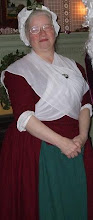
To inspire us all to spin...
Boston News-Letter and New-England Chronicle February 16, 1769
NEW-LONDON January 7.
On the 16th Instant; the Wife of Mr. John Vaughan of Lebanon, agreed upon a spinning Match with a neighboring young Woman; they began their Work three quarters of an Hour after Sunrise, and left off at Nine o’Clock in the Evening of the same Day; in which Time Mrs. Vaughan spun seven Skeins and two Knots of fine Linnen Yarn, each Skein containing 15 Knots; The other Person spun 6 Skeins and 10 Knots, the Skeins of equal Bigness with the first mentioned.—[Would the Sex in general apply their Hands to the Distaff, instead of the idle Apparatus of the Tea-Table, perhaps we need not always be beholden to Asia for our Food, or Europe for our Cloathing.]
How much is that? A thread of linen is 2.25 yards and a knot is 40 threads. A skein may contain any number of knots just like a modern skein may contain any number of ounces. So a skein containing 15 knots has 1350 yards (I think-math isn't my strong point even with a calculator)
We may not get that much spun on Sunday since the spinning matches of the 1760s lasted from dawn to dusk and we'll only be spinning from 1-5.
Friday, May 15, 2009

Tuesday, May 12, 2009
Spinning Bee Buzz
The New Hampshire Sheep and Wool Festival was this past weekend and I again had a booth to promote the Colonial Spinning Bee. Quite a few people expressed interest so here's hoping they will join us. The long range weather says it should be in the 70s. Here's hoping for a good event.
Pot luck lunch starts at 11:30, spinning follows, stash reduction sale and swap all day.
For details see
http://home.earthlink.net/~judycat/id2.html
Pot luck lunch starts at 11:30, spinning follows, stash reduction sale and swap all day.
For details see
http://home.earthlink.net/~judycat/id2.html
Friday, May 1, 2009
from The Boston Post Boy April 22, 1765
It is with the greatest Pleasure we hear of so many of the principal and other inhabitants of this Town refusing to purchase what little Lamb is brought to our Market. We cannot but hope they will continue in this good Resolution, not only as there is such a Plenty of other Provisions, but take into Confidensideration the many Advantages which must naturally arise on having a large Quantity of Wool among us, the Produce of which for one Season only, will be so great as to carry on a considerable Manufacture, at least of necessary Wearin Apparel for ourselves and Children: and we hop(e) in a few Years it will be accounted a Virtue in the Ladies to wear a Garment of their own Spinning.
It is with the greatest Pleasure we hear of so many of the principal and other inhabitants of this Town refusing to purchase what little Lamb is brought to our Market. We cannot but hope they will continue in this good Resolution, not only as there is such a Plenty of other Provisions, but take into Confidensideration the many Advantages which must naturally arise on having a large Quantity of Wool among us, the Produce of which for one Season only, will be so great as to carry on a considerable Manufacture, at least of necessary Wearin Apparel for ourselves and Children: and we hop(e) in a few Years it will be accounted a Virtue in the Ladies to wear a Garment of their own Spinning.
Tuesday, April 28, 2009
Starting Late Again
The Colonial Spinning Bee is a little less than 3 weeks away and I have done very little to advertise it. So, today I will send out emails to all the appropriate lists and beg you all to forward the info to you chat groups and generally talk it up. It really is a fun event with a pot luck lunch and a beautiful site with lots of parking. As of last year there are flush toilets available instead of the out house which is a really great addition! We should have a general fiber vendor and we might get Wicker'd Good baskets this year.
I would like to promise that I will post a bit of historical info and updates on a daily basis but that may not happen but I will post more regularly with info on the spinning matches of the 1760s that the Colonial Spinning Bee is based on.
I would like to promise that I will post a bit of historical info and updates on a daily basis but that may not happen but I will post more regularly with info on the spinning matches of the 1760s that the Colonial Spinning Bee is based on.
Sunday, March 22, 2009
Getting Started

I've been running the Colonial Spinning Bee at the "Old Chelmsford" Garrison House in Chelmsford, MA for the past 8 years or is it 9 years... When I started it I was really hoping that by now it would be this really big and anticipated event with lots of spinners and vendors. The whole idea started more than 30 years ago when I first heard of the "spinning bee's" that were held in colonial New England at which "huge" numbers of women gathered to spin and make their policial statement against the importing good from England. I tried to organize one at the National Park in Concord one year but couldn't get enough re-enactors who could spin and had period correct wheels so the "bee" had to wait 25 years. When I tried again I thought I'd make it an event that would welcome spinners from both modern and historic backgrounds. In the beginning I got mostly 18th century re-enactors, the year after that the numbers were more balanced and since then it has been mostly modern spinners. Actually, the last few years it has been only a few modern spinners. Several things happened, to bring in spinners you need to have vendors and once a vendor gets known they don't do small events like mine-which is understandable. Another problem has been rain, it has rained 3 of the past 4 years, 4 of 4 if you count the sprinkles for the last hour of the event last year. There is also the fact that it is the weekend between the NH and MA Sheep and Wool Fests. This worked to it's advantage some years and against it others. Being a glutton for punishment I'm trying again this year, May 17 http://home.earthlink.net/~judycat/id2.html
The concept is a good one and the historical significance in a year of cut backs is appropriate. So, I figured I'd start a blog to keep up the interest and share some of the information I've found out about what were really called "Spinning Matches" and were made up of about 20 girls and the occasional older woman.
Here is a poem from 1750
The Loom, the Comb, the Spinning Wheel, Would much promote this
Country's Weal If we could wear more our own Woollen:
We should have kept our Coin and Bullion.
For sending of the Coin away,
Has made all Sorts of Trade decay;
How shall poor Tenants pay their Rent?
Now all the Coin away is sent.
How shall Folks live and Taxes pay,
When all the Money's sent away;
Let Merchants then join Hand in Hand, To bring in Money to our Land.
But if this Counsel they dispise,
And their own Interest only prize
They will bring Ruin on this Land;
As quickly all will understand.
For now the Money is so gone,
That there is little to be done.
And more and more trade will decay,
As all will feel from Day to Day.
O that a way they would find out,
To make this Trade to face about;
And bring the Money here again!
But I'm afraid I speak in vain.
Therefore I now conclude and say,
Pray let 'em send no more away;
But keep in that which does come in,
And never send it out again.
The Boston Gazette, or Weekly Journal
issue 1568
April 3, 1750
The concept is a good one and the historical significance in a year of cut backs is appropriate. So, I figured I'd start a blog to keep up the interest and share some of the information I've found out about what were really called "Spinning Matches" and were made up of about 20 girls and the occasional older woman.
Here is a poem from 1750
The Loom, the Comb, the Spinning Wheel, Would much promote this
Country's Weal If we could wear more our own Woollen:
We should have kept our Coin and Bullion.
For sending of the Coin away,
Has made all Sorts of Trade decay;
How shall poor Tenants pay their Rent?
Now all the Coin away is sent.
How shall Folks live and Taxes pay,
When all the Money's sent away;
Let Merchants then join Hand in Hand, To bring in Money to our Land.
But if this Counsel they dispise,
And their own Interest only prize
They will bring Ruin on this Land;
As quickly all will understand.
For now the Money is so gone,
That there is little to be done.
And more and more trade will decay,
As all will feel from Day to Day.
O that a way they would find out,
To make this Trade to face about;
And bring the Money here again!
But I'm afraid I speak in vain.
Therefore I now conclude and say,
Pray let 'em send no more away;
But keep in that which does come in,
And never send it out again.
The Boston Gazette, or Weekly Journal
issue 1568
April 3, 1750
Subscribe to:
Posts (Atom)